K-Town Lament
We find the place we're meant for

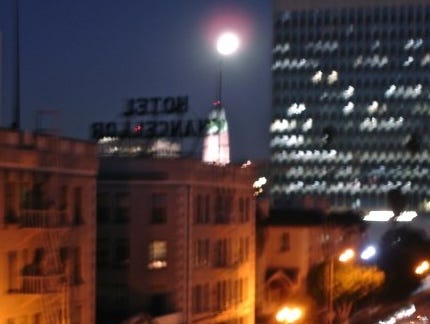
“Ahh! Ha, ha, haahh! Praise God!”
That’s how my Sundays began at 7th and Catalina. The Korean guy in the corner apartment was some kind of evangelical and would rise at 7 a.m. cranking a praise broadcast that filled him with the Holy Spirit. His joy felt forced, but he was determined and I could respect that. The sound of his reverie echoed down the courtyard and through my window as if he was right outside, hovering five floors up like some kind of Judgement Day apparition.
“Ah, ha, ha, ha! Hallelujah!”
I didn’t want to harsh his high but after a year of this I’d had enough, staggering hungover down the hall and banging on his door.
“Jesus Christ, it’s 7 a.m.! On a Sunday!”
He said nothing, just nodded and went over and turned down the radio. The next Sunday there was no rapturous laughter. Nor the Sunday after. At the end of the month he moved out. I felt like an asshole. But I could sleep.
Besides the holy roller, I was getting confessional phone calls at dawn. Most of us still had a landline back then, and if the phone rang in the wee hours it meant someone was in jail or dead. So you picked up. Instead, it was a woman with a heavy Asian accent.
“I sorry,” she said. Over and over.
“Lady, you have the wrong number.”
“I sorry.”
“Lady, please…”
The calls would stop for a while, then start up again. “I sorry…”
“Lady, it’s 5 a.m. Give me a break!”
“I sorry,” she slurred.
“Okay. Okay… I forgive you.”
There was silence on the line. “I forgive you,” I repeated, then hung up and went back to bed.
The calls stopped.
Koreatown in the early aughts was a wild frontier. The nights rang with ambient gunshots and the thudding of police helicopters. Apartments were big and cheap. My place was 700 sq ft with ten-foot ceilings. The building had been a luxury residence in the 1930s with a high-end bar/restaurant on the bottom floor, and on top, a penthouse suite where the owner and his wife still lived. He’d been there since the late 1940s; like the building, he was on his last legs.
I gave his wife a ride to the ER after the ambulance took him away. Veronica was her name, silver haired with the poise of a woman who was accustomed to turning heads in her day, like one of Raymond Chandler’s dames who’d wandered into our dull and tawdry century. “You’re taking Wilshire?” she said, riding shotgun in my pickup. “Seventh street has less traffic.” I cut over to 7th and got her to the hospital as fast as I could. Her husband came home the next day, then went back to the ER a week later. Then he didn’t come home at all.
By the time I moved in the Windsor felt more like a flophouse. Residents of dubious legality crammed four people into one-bedroom apartments. Some of my neighbors had the shuffling gait and glazed eyes that told of anti-psychotic medication. The hardwood floors had been covered with cheap carpet. The elevator groaned and shuddered. One night it came to a grinding halt between floors—trapping me with a girl I’d pulled off a barstool at the HMS Bounty.
“Let’s have sex!” she said, pawing at my belt.
“Hold on. It smells like someone pissed on the floor.”
I didn’t know being stuck in an elevator is a female fantasy, instead feeling only the beginnings of claustrophobic panic… But the firemen soon arrived with axes and pry bars and we were freed to have sex on my futon like a respectable couple.
Watching us from across the street was the abandoned husk of the Ambassador Hotel, where Bobby Kennedy caught the fatal bullet from Sirhan Sirhan in ‘68. It lingered empty for years, shuttered bungalows clutching stories of shadowed power and debauchery that would make P-Diddy proud. Until the city tore it down and put up a K-12 school. The silent mystery was gone, replaced by the voices of obese, hyperactive children who ran screaming from 8 a.m. until someone turned blue and flopped on the concrete, when EpiPens were unsheathed and an ambulance rolled up shrieking at the sky.
Everywhere were remnants of a great city fading away like the ruins of Martian civilization in Bradbury’s novel. The great Deco apartment buildings where uniformed doormen once greeted residents now had laundry hanging from fire escapes and parakeet cages propping up cracked windows. The Brown Derby, where Clark Gable, Carole Lombard, Bing Crosby and all the Rushmore faces of Hollywood once dined—razed to put up a Korean mini-mall with a video arcade and noodle bar.
Taylor’s Steakhouse somehow survived, where it’s rumored Sinatra and his Rat Pack degenerates kept reserved booths in back. I dined there with a girl who was gracious enough to pick up the tab when I was out of work. She was altruistic like that, a nurse who’d done a volunteer year in an equatorial country and was quick to correct me when I complained about my neighbors dumping trash in the gutters.
“You don’t understand!” She leaned in. “Where they come from, it’s a sign of prosperity to throw trash in the street.”
“I grew up poor. Maybe I should do it too…”
“No.”
She had a dark side. A fondness for cocaine and rough sex. She was a feminist who worked at a women’s clinic, so I was surprised when she asked me to choke her. But I’d learned that the face a woman shows the world is only half the picture. Less than half, really. After I was working again—a corporate job in Orange County that paid well by my standards—I took her out for a steak dinner at the Pacific Dining Car on 6th St., intending to repay her previous kindness. $200 on my card.
The next day she dumped me. Well played, sister.
But there were more to come. It was the heyday of OkCupid, Nerve, Match... Everyone was chasing their desires online; people pushing forty hooking up like horny college kids. A divorced mom from Anaheim squeezed in an afternoon quickie with me in my ghetto apartment before rushing back to pick up the kids from school. She was trying her hand at erotic fiction and emailed me one of her dirty stories. It was Fifty Shades stuff: He instructed me to keep my hands on my hips and bend over and pick up the apple with my mouth... She may have titles for sale on Amazon now. I don’t remember her name.
A Mexican girl who lived in West Hollywood came at me with the gusto of a porn star, as long as she didn’t have to come to my neighborhood. A natural blonde who did yoga and drank like an Irish knuckle-brawler almost had my heart, but something told me it would go badly (I found out much later she’d hooked up with my best friend). A bipolar redhead told me stories of attending a Hollywood sex club with her boyfriend, where he sat in the cuck chair and watched as she rode a guy boasting ten inches.
“So, how was it?”
She shrugged. “I wanted my boyfriend, not him.”
When we got down to it she was so loud I was afraid the neighbors might dial 911. But we both knew better. On my block, screams in the night were as common as crickets.
Meeting a studious former ballerina the old-fashioned way, in a pretentious coffee house, brought a merciful end to my fuckboy days. Like everyone who landed near me, she’d seen dark times. An abusive artistic director went Black Swan on her, driving her to quit the profession she’d worked toward since age nine. She put herself back together and got a lawyer, using the settlement funds for grad school. She was fragile and hardy like that, cheerful one day then sinking into distant blackness, until another concrete sunrise brought her back to life with the broken city outside.
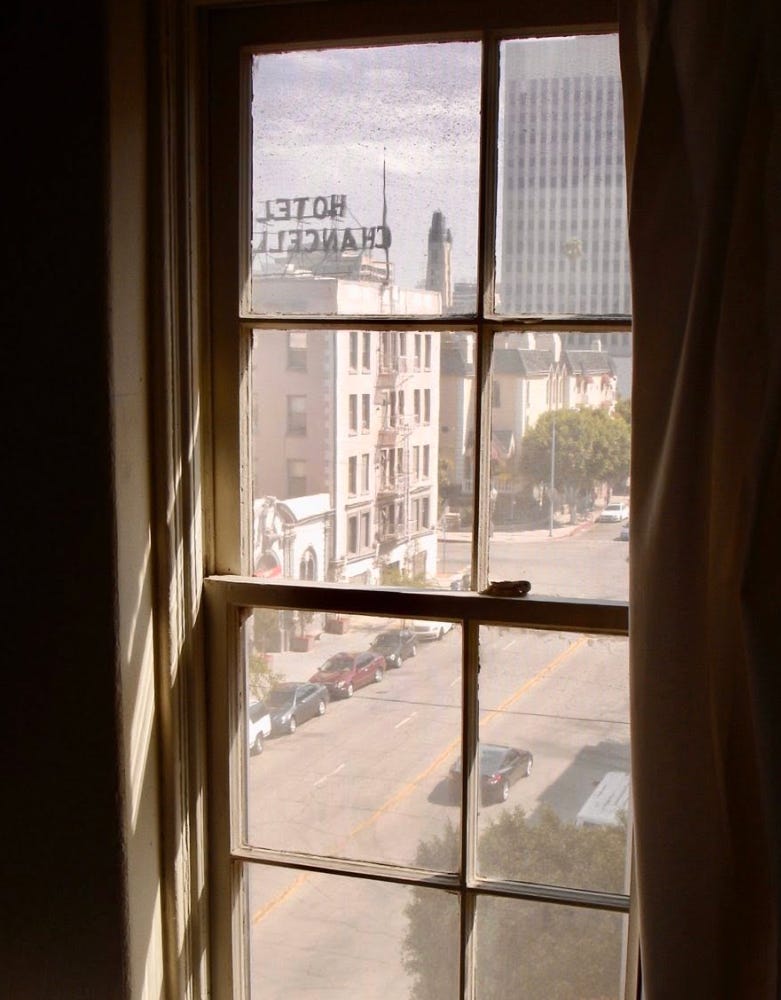
We had six months of playing house in that faded luxury apartment with its cathedral window spilling pale morning light across the worn blue carpet, lounging on the fire escape where we drank and smoked and watched flocks of wild parrots roost in the sooty palms. I knew she wanted the real thing, but I choked, deluded that I was still young and had great solitary adventures ahead of me. She moved up the coast and left the door open, for a time. Until a guy with promise and solid plans for the future came along. Their two kids must be headed to college about now.
I moved out of K-Town, heading north to a neighborhood where I’m not suspected of being a cop for having a white face. There’s no abandoned furniture on the sidewalks, just tattooed couples enjoying crepes at faux-Euro cafes, and lithe young women strutting to Pilates classes in LuluLemon outfits that cost nearly as much my previous rent. No trash backing up the gutters when it rains, no gunshots or stripped cars resting on rims, and only the occasional police-helicopter pursuit.
But there was a freedom to living among ruins. Wandering streets where avaricious men and covetous women once schemed and dreamt and forced a city into existence out of dusty orange groves, the same sun beating down on cracked sidewalks where no one knows you and you’re free to forget yourself.
Some days I think I miss it. But K-Town is still there, shabby and chaotic. We can go back to a place, but not a time. The grey hairs on my pillow tell me the days of being able to strike out and start over are fading over the horizon. But there are mornings when my phone jars me out of sleep, and with fractured, unbound consciousness I half-remember, wondering if it’s my turn to hear those words…
“I forgive you.”