Notes on Dying
The family we drift from and the storie s they take with them

My uncle Jim died in November. We all knew it was coming. He was 89 and could barely get out of a chair. They’d amputated his little toe a few weeks previously. Diabetes. The toe had turned black and when his home-care aid saw it she told my brother to get him to a hospital. After surgery they took him to a care facility to recuperate. It was from there that he called me while I was in a bar watching the World Series. Not that I’m a big baseball fan, but I needed a reason to escape my four walls.
“I’m scared,” he confided from 3,000 miles away. “I’m shaking all over my body.”
“Don’t worry,” I told him. “I’ll call your doctor. Your family loves you, and we’re gonna be there for you!”
“Where are you?” he asked.
“The Dodgers won the Series and the bartender gave out free champagne, so I’m kinda lit.”
Finally he laughed. “Just know that if I stay or go. I’m okay with it.”
My father had died the previous year. Jim’s other brother, my uncle Mike, died decades before when I was just out of college; sepsis. Jim was the last of his line. He had no children. Not even an ex-wife. He was handsome enough to get attention from women, but never had a romantic relationship that anyone knew of. My father once suggested on the down-low that his brother might be, you know…
But I never got that vibe from him. He seemed more like someone who’d been deeply wounded early on, like the 1940s Catholic upbringing he endured—with its harping on Lust as a venial sin, the beatings, the internalized shame about normal human drives—bored into his psyche with such force that he could not conceive of sexuality outside of it. He once told me of a college girlfriend he’d spent a night with on the beach. “No sex,” he emphasized, as if I might rat him out to the Mother Superior. “She went back to her hometown the next summer,” he said. “Then… she killed herself.” When I was a twenty-something embarking on the cliche Euro-backpacker trip, his only advice to me in a letter was: “Avoid whores of all kinds.”
A few days after that barroom call I was on a red-eye back east. My older brother had already dealt with my father dying, and my father’s wife passing four months before that—driving them back and forth to hospitals, picking them up off the floor, mopping up after accidents, negotiating with doctors who expected life-or-death decisions to be made on the spot. When uncle Jim started to spiral my brother called me drunk, manic... “You hafta come back!”
The morning after I landed we drove to the ICU and found my uncle half out of his bed. He’d been sober for more than 20 years but now acted like he was back in the bag. “These nurses are a bunch of dopes! How can I get some goddamn decent food in this place?” They had him on oxycontin for his amputated toe, and I figured it out… For an alcoholic, one high is the same as another. The pills turned him into the uncle I remembered from childhood; the guy who could make you spit out your food laughing or silence a room with a cutting quip.
It was that formidable intelligence that took him from a dingy working-class town outside Boston to a minor-league Ivey. We found his report card from 1962 while cleaning out his apartment: a lot of B-minuses and C-pluses. “I never worked too hard at anything,” he once confessed to me. We found his framed diplomas, bachelors and masters, even his 1953 class ring from high school still in its velvet case—all the milestones we’re told are so important, only to go into a closet and never be seen again. And we found something else… A photo of a woman clipped from a memorial-service notification from a few years previous. My uncle had placed her picture in a sterling silver frame, kept by his bedside. Whoever she was, he took it to his grave.
After the ICU they took him back to the care home. A decent place, but he hated it, sharing a room with a guy who appeared to have Tourette’s, hunched over on his bed like Gollum. “Fuckin’ TV won’t work!” My brother refused to go inside. He’d had enough of sickness and death and was happy to let me deal with it. I brought my uncle a copy of the New York Times and an Orange Crush, an indulgence he refused to give up despite his diabetes. I remembered it was my favorite drink as a kid, too. He was alert again and wanted to know everything he’d missed while doped up in the ICU. “Did Trump pull off his Gaza deal? What about the Epstein files?” He chugged the soda and I filled him in. It felt like maybe he would walk out of there.
When I returned a couple days later, there was a large male nurse standing over him. My uncle lay motionless with eyes rolled white, his head back and mouth agape. “His labs are off,” the nurse said in a thick African accent. “We’re sending him back to the ER.”
A few minutes later the EMTs rolled a gurney into the room… Two fit young men and an equally fit young woman who, in that place of diminishing hope, looked like they’d descended from Mt Olympus. They asked me his name, how he was doing… They showed him great care and respect, something I would not have expected. But then I live in a city where homeless people OD and lie dead on sidewalks and in parks while the rest of us drive past checking our phones. It’s easy to forget there are still places, rusty and unhurried, where people look out for each other.
The EMTs took him back to the hospital and the overworked ER doctor told us what we already knew. “Well, he’s very sick. He’s got sepsis. They got the infection from his toe under control, but a different strain spread to his colon.” My brother wandered outside and left me to deal with all of it again. “We can move him to comfort care,” the doctor offered. “Or, we can move him to a room upstairs and put him on an antibiotic drip. Take a wait-and-see approach.”
That was the the term they’d used for my father: “comfort care.” I didn’t know then that it meant they doped you up and waited for you to die. It’s a hard thing, to stand there talking about ending someone’s life as if you’re putting down an old cat. But we all end up there. Neither my brothers nor I have any kids. When our time comes, we’ll be lucky if one of us is still around to make the call. For the last one, maybe somebody in the hall will flip a coin; I kinda like the thought of that. I dodged by choosing the wait-and-see option.
It turned out there were no ICU rooms left; so we got a call that night saying they were transferring him to another hospital. Later, a doctor from the new hospital called and asked if I thought Jim would be okay with them amputating half his foot. “I don’t think he would want that. He barely survived having his toe removed.” The doctor agreed and decided to do more tests instead. Sometime in the early a.m., my brother got a call from another doctor asking if my uncle would be okay with them removing his colon. “No,” he told them.
Jim’s new doctor was an attractive young woman with large brown eyes who showed genuine interest in him, what he did for a living, his interests… I told her he’d been an English teacher and she seemed impressed. They put him on antibiotics and a drug to keep his blood pressure stable. We sat with him for a while and I felt relieved not to have chosen the black pill the night before. He was awake and talking, making sure we paid his life-insurance premium—alive.
The next day we were pulling into the hospital parking garage when my phone buzzed. It was the pretty young doctor. “He’s having trouble breathing and we’re afraid he might be passing away.” When we got up to his floor we found him surrounded by doting nurses; they’d just finished feeding him soup & crackers and one of them was combing crumbs out of his white beard. His eyes were barely open but he seemed to light up when my brother and I walked in.
Soon another doctor, young and subdued, took us into a private room and gave us the bad news. “His organs are shutting down. His kidneys have stopped working. He hasn’t produced any urine in 18 hours.”
We nodded. It was the end.
Back in his room, they stopped the vasopressor medication and the nurses all gathered around. The pretty doctor asked if we wanted to pray. “I’m a failed Buddhist,” I told her. “But I remember learning that when you touch a dying person, it should be on the top of the head; so their energy winds rise up through their crown chakra for a higher rebirth.” So she put her hand atop his head and I held his hand and my uncle’s eyes drooped… He kept talking to me, barely a whisper, trying to tell me something, or maybe he was seeing someone else. The heart monitor slowed: 25, 22, 19…
I got up and walked to the window. My uncle wasn’t afraid of death, but he did not welcome it. “I like being alive,” he told me the year before. “I’m not one of these guys who wants to check out.” He lived alone and, if not for my brother driving him to his doctor’s appointments, grocery store, CVS… he would have been helpless. But he kept going. Even after falling in the bank parking lot one summer and laying there on the hot asphalt for over an hour until someone finally noticed him and called 911, he kept going.
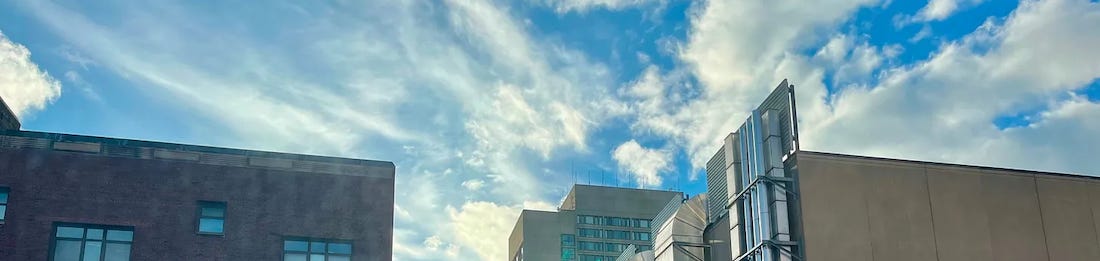
I stood at the window looking out at the world he did not want to leave… The storm clouds had parted and sunshine spilled onto the cold brick buildings (the view in the photo above). I thought of the uncle I barely bothered to know, the man my father often derided as “an asshole,” the same man who gave me a Lionel locomotive for Christmas when I was ten, and how embarrassed he was to have forgotten to remove the price tag when I exclaimed “Fourteen dollars!” I stood there and thought of his lonely life and the love he had denied himself, how as a fellow middle-child of three brothers I had always been afraid to turn out like him, and yet somehow I had—believing each time love came my way that this wasn’t it; that the main attraction was yet to come; until I was standing alone in a bar watching a game I didn’t care about, in a place Kerouac called “the loneliest and most brutal of all American cities.” The tears spilled hot and dumb down my cheeks and when I turned back to the bed the pretty young doctor removed the stethoscope from my uncle’s chest and smiled at me. “Two-twenty-two.”
He lay there with his head to one side, eyes closed like he was napping in his recliner. My brother and I thanked the doctors and nurses, gathered up our things and went down the elevator and out into the cold New England day. It was a windy afternoon and the sun was high in the sky. There was still time maybe, to do something.
Tim, what a poignant read ❤️.
Stephanie
Clear, unvarnished account. Let's the reader do the feeling.